Abhinav Kumar Dwivedi

Product leader tailored for the new internet. Building digital products that matter.

Sitemap

  • Index
  • Projects
  • Blog
  • About

Socials

  • LinkedIn
  • x
  • GitHub
  • Email
© 2026 All Rights Reserved
New Delhi,India / Remote

Career GPS: A Decision Framework for Career Transitions

Reducing ambiguity in career transitions through clarity and decision support

0%

Career GPS: A Decision Framework for Career Transitions

Reducing ambiguity in career transitions through clarity and decision support

View Deck
Product Manager2025
Career GPS: A Decision Framework for Career Transitions
01

The Challenge

Career transitions fail at skill translation

  • Users apply → get rejected → receive no explanation

  • They don’t know what to fix or whether they’re even close

Transferable skills exist, but aren’t legible

  • Experience doesn’t map cleanly to job descriptions

  • Resumes show titles, not decision-making or impact

  • Users are forced to guess their fit

Upskilling increases confusion

  • Random courses

  • Scattered content

  • No link between learning and hiring outcomes

  • Progress feels busy, not meaningful

Guidance breaks when context matters

  • Family advice = “safe paths”

  • Online advice = generic

  • Paid mentors = sales-led

  • No one helps users decide what applies to them

The compounding cost: confidence

  • Momentum slows

  • Risk appetite drops

  • Transitions stall or die

  • Not because users lack ability — but because they lack signal

02

The Goal

Primary goals

  • Establish user clarity before action
    Help users understand where they stand today before recommending next steps.

  • Reduce guesswork in career decisions
    Replace blind applications, random courses, and trial-and-error with informed choices.

  • Drive concrete next steps
    Ensure users leave with a clear, actionable direction—not just insights or inspiration.

Secondary goals

  • Build confidence during transition
    Help users feel capable and in control, even amid uncertainty.

  • Support better decisions, not rushed outcomes
    Success wasn’t defined by immediate job switches, but by higher-quality career decisions.

Overview

Career GPS is a response to a specific kind of career ambiguity:
people in transition know they have valuable experience, but don’t know how it maps to what comes next.

The core problem wasn’t lack of ambition or effort.

It was translation.
Job descriptions were vague. Courses were disconnected from outcomes. Existing tools assumed users were either job hunting or starting from zero. None were built for someone mid-transition who needed contextual guidance, not generic advice.

I intentionally did not build another job portal or an education marketplace.
Those tools optimize for listings and content.
They don’t help users make high-stakes career decisions with confidence.

The turning point came when we tested feasibility.
It became clear that this couldn’t be a feature layered on top of resumes or courses.
The solution had to work as a system—one that connects skill mapping, role clarity, and actionable next steps, while accounting for uncertainty during transitions.

Career GPS is designed to cut through that ambiguity.
It helps individuals understand where their existing strengths fit, identify future-relevant opportunities, and follow a clear, practical path forward- without forcing them into predefined job titles or learning funnels.

In-Depth Analysis

Context & Constraints

01 — The Context

Context & Constraints

"The hardest constraint wasn’t technology - it was helping users make confident decisions with incomplete information."

Career GPS was designed under constraints that made generic career solutions unusable.

Key constraints

  • Low time, high cognitive load
    Users were mid-transition professionals. Long onboarding or vague exploration would fail immediately.

  • Messy, unreliable inputs
    Resumes and profiles reflected past titles, not future capability. The system had to work with imperfect data.

  • High emotional stakes
    Career decisions involved fear of wasted time, money, and long-term regret. Trust and explainability were non-negotiable.

  • Intentional scope limits
    This was not a job board, course platform, or mentorship marketplace. It focused on clarity and decision support.

  • Depth over breadth
    Fewer transition scenarios were prioritized to deliver sharper, actionable guidance.

Key Insights

Designed for users with low time, high anxiety, and imperfect data
Optimized for decision-making, not content consumption
Chose focus and clarity over feature breadth

The Product Approach

Stage 01

Problem Framing

Defined the real transition pain by focusing on ambiguity, not surface symptoms.

1
Stage 02

User Research

Used interviews, surveys, and secondary data to identify repeated failure patterns and rule out generic solutions.

2
Stage 03

Problem Decomposition

Broke “career guidance” into skill translation, role clarity, and decision paralysis to make it solvable.

3
Stage 04

Prioritization

Evaluated problems by frequency, intensity, and impact to focus on what blocked progress most.

4
Stage 05

System Design

Designed an end-to-end flow from clarity to action instead of isolated features.

5

Decisions That Shaped the Product

Decision 01

Focus on career transitions, not job search

Most existing tools optimize for job discovery and applications.
However, research showed users were already applying — the failure was happening before that stage, when users couldn’t tell where they fit or what to fix.

Selected Path

The Decision

Design Career GPS specifically for people mid-transition, prioritizing clarity and direction before job search or applications.

Outcome & Impact
Solved a deeper, earlier problem in the journey
Differentiated clearly from job boards
Slower perceived gratification compared to “apply now” tools
Paths Not Taken
Build a job-search-first platform
Rejected

Optimize listings, matching, and applications

Why:Didn’t address why users were failing or feeling stuck in the first place

Build a resume optimization tool
Rejected

Improve ATS scores and keyword matching

Why:Treated symptoms, not the underlying confusion

Decision 02

Make skill translation the core problem

Users repeatedly said they “had skills” but didn’t know how those skills mapped to roles, job descriptions, or recruiter expectations.

Selected Path

The Decision

Anchor the product around translating existing skills into role-relevant language and signals.

Outcome & Impact
Reduced blind applications
Made guidance feel personalized and relevant
Required working with messy, imperfect user data
Accuracy and explainability over automation ease
Paths Not Taken
Role discovery first
Rejected

Show emerging roles and career paths upfront

Why:Created more options without resolving fit

Upskilling-first approach
Rejected

Recommend courses based on interests

Why:Increased confusion without clarity on gaps

Decision 03

Design the solution as a system, not features

Career guidance problems were interconnected — solving one in isolation didn’t move users forward.

Selected Path

The Decision

Design an end-to-end flow (mapping → clarity → action) instead of standalone tools.

Outcome & Impact
Clear progression and narrative for users
Stronger product coherence
Higher design and integration complexity
System coherence over build simplicity
Paths Not Taken
Feature-based toolkit
Rejected

Separate tools for resumes, roles, and learning

Why:Fragmented experience and shallow impact

Solutions & Features

01
Core Feature

Skill-to-Role Mapping Engine

Turns existing experience into role-relevant signals users can act on.

The Challenge

"Users know they have transferable skills but can’t tell how those skills map to specific roles or recruiter expectations."

The Skill-to-Role Mapping Engine analyzes a user’s existing experience and reframes it in the context of target roles.
Instead of asking users to start from scratch, it helps them understand how their current skills translate into role expectations, highlighting gaps that actually matter.

This shifts users from guessing their relevance to making informed decisions about where they fit and what to improve next.

Capabilities

  • Skill extraction from existing experience
  • Role-aligned skill mapping
  • Clear identification of gaps vs strengths
  • Language aligned with recruiter expectations
Reduced blind applications by giving users a clear view of fit before applying or upskilling.
02
Core Feature

Career Clarity Snapshot

Shows users where they stand before telling them what to do next.

The Challenge

"Users rush into courses or applications without understanding their current position, leading to low confidence and wasted effort."

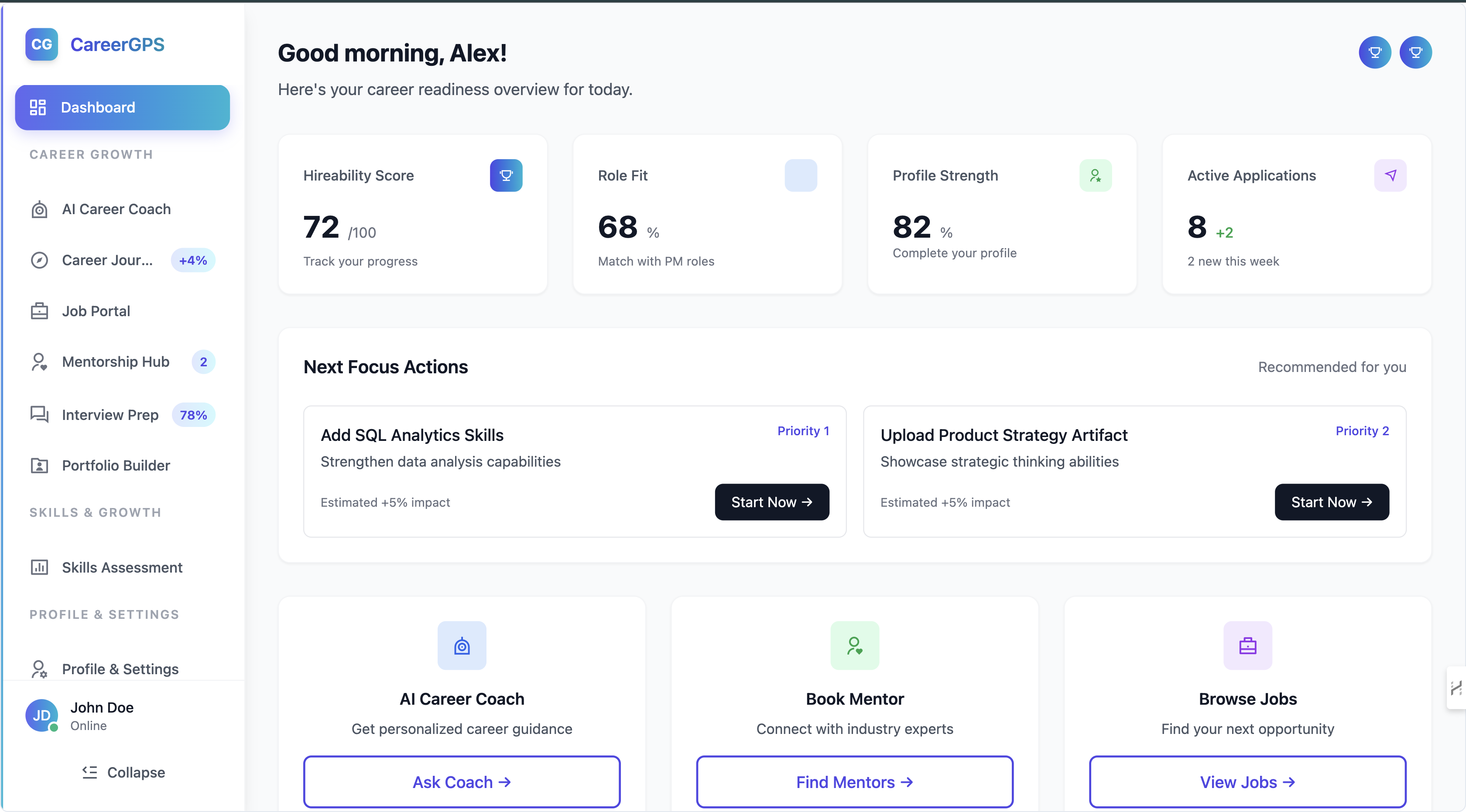
The Career Clarity Snapshot gives users a concise, high-signal view of their current career position.
It answers three questions upfront:

  • What am I already strong at?

  • Where am I misaligned?

  • What actually needs attention right now?

By grounding users in their current reality, the product reduces anxiety and prevents premature or misaligned actions.

Capabilities

  • Current-state career positioning
  • Strengths vs gaps visualization
  • Confidence-building framing
  • Explainable insights, not black-box scores
Helped users make fewer but more confident decisions by establishing clarity upfront.
03
Enhancement

Guided Next-Step Pathways

Turns clarity into concrete, low-regret next steps.

The Challenge

"Even after gaining clarity, users struggle to decide what to do next without second-guessing themselves."

Guided Next-Step Pathways translate clarity into action.
Instead of overwhelming users with options, the system recommends a small set of prioritized next steps aligned with their context, goals, and constraints.

This ensures momentum without sacrificing confidence or intent.

Capabilities

  • Context-aware recommendations
  • Prioritized actions over endless options
  • Alignment with user goals and constraints
  • Designed to reduce overthinking, not increase it
Reduced decision paralysis by converting insights into actionable, prioritized steps.

Outcome & Impact

Simulated Outcome

Early signals showing reduced ambiguity, stronger confidence, and more intentional career decisions.

Project Goal

Help users reduce guesswork during career transitions by gaining clarity on their current position, skill relevance, and next best steps—before committing time or money.

Business Impact
💬 Qualitative

Reduced blind career actions

Users reported applying to fewer roles and enrolling in fewer random courses after gaining clarity on where their skills actually fit.

Observed through interview feedback and scenario walkthroughs where users reflected on how they would act differently after using the solution.

Goal Alignment
Reduce guesswork in career decisions and prevent low-confidence actions.
User Impact
💬 Qualitative

Improved confidence during career transitions

Users expressed higher confidence in explaining their skills, gaps, and next steps without second-guessing themselves.

Measured through qualitative feedback during interviews, focusing on language shifts—from uncertainty to clarity—when users described their career position.

Goal Alignment
Build confidence and clarity before action.
User Impact
💬 Qualitative

More intentional career decision-making

Users demonstrated more deliberate thinking about next steps, prioritizing relevance and fit over speed or volume of actions.

Assessed by comparing pre-solution and post-solution decision narratives during interviews and concept testing.

Goal Alignment
Help users make better decisions, not just faster moves.
Retrospective

Learnings

What this project changed about how I think and design.

01

Key Takeaway

Core lesson

Clarity created more value than speed.
I assumed users wanted faster paths to action, but what actually unlocked progress was helping them understand where they stood before moving forward. Once clarity was established, users made fewer decisions—but with more confidence.

02

The Surprise

Unexpected discovery

Most users weren’t blocked by lack of skills, but by lack of translation.
I expected upskilling to be the primary gap. Instead, users struggled to explain and position what they already knew. The real friction was articulation, not acquisition.

03

Paradigm Shift

New perspective

Generic guidance is not neutral—it’s harmful.
I believed broad, widely applicable advice was safer. User feedback showed it increased doubt and second-guessing. Contextual guidance, even when narrower, built more trust and confidence.

04

The Mistake

What went wrong

Early thinking leaned toward feature completeness.
Initial ideas risked becoming a set of disconnected tools. What was missing was a clear flow. The product only became coherent when I treated it as a system rather than a collection of features.

05

Growth Area

Future opportunity

I would validate decision quality with stronger longitudinal signals.
While early qualitative feedback was strong, measuring how clarity translated into long-term outcomes (role changes, satisfaction, confidence over time) would strengthen the product and its impact.